Remote Rocketship features and their limits
| Advertised capability | Potential use | What it does not establish |
|---|---|---|
| Search and filters | Narrow a discovery list | That every result meets employer eligibility rules |
| Saved-search email alerts | Support a regular review routine | Guaranteed relevance, timeliness or delivery |
| Resume and cover-letter customization | Help draft an application | Accuracy of every suggested statement |
| Resume matching | Identify requirements to inspect | Interview probability or employer approval |
| Training course | Provide search guidance | A verified improvement in hiring outcomes |
| API, CLI and MCP access | Support permitted personal workflows | Permission to scrape or build a competing board |
Choose by the task you need to complete: filters help narrow discovery, alerts support a routine and resume tools help prepare documents. None replaces checking the employer’s requirements. Our main review weighs those capabilities against the cost of another subscription.
Search filters: inspect the underlying requirement
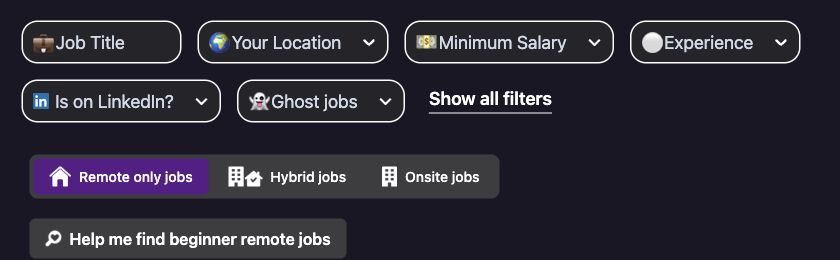
The homepage describes country and time-zone filtering. The pricing page lists salary, visa sponsorship and seniority among paid search options. These are useful categories to investigate because remote does not mean every employer can hire in every country. A filter narrows the list; reading the original posting confirms the actual condition.
If a role’s location wording is ambiguous, record it as uncertain rather than assuming permission. Work authorization, payroll coverage, shift requirements and occasional travel can all matter. The jobs checklist explains what to confirm before preparing an application.
Alerts: fewer useful notifications beat a bigger inbox
The provider advertises hourly or daily email alerts from saved searches. A defined title and location make alerts easier to evaluate than a broad search for any remote position. Choose a schedule that leaves time to read and act on matches rather than collecting messages indefinitely.
Review whether alerts reduce a repeated manual task and whether the original employer link still works. Change the search when it repeatedly produces ineligible roles. Faster notification alone does not make a poor-fit application worth submitting.
Resume customization: check the facts line by line
Resume and cover-letter tools are advertised on paid plans. A tool may help organize language around a job’s requirements, but it should never supply qualifications you do not possess. Compare suggested text with your actual work and keep responsibility, scope and results accurate.
Avoid uploading unnecessary identifiers or confidential materials. Read the live privacy terms before sending a resume to any third-party tool. Check whether the file is stored in an account, how matching data is used and what deletion options apply, especially if your work has confidentiality requirements.
Matching is guidance rather than a hiring score
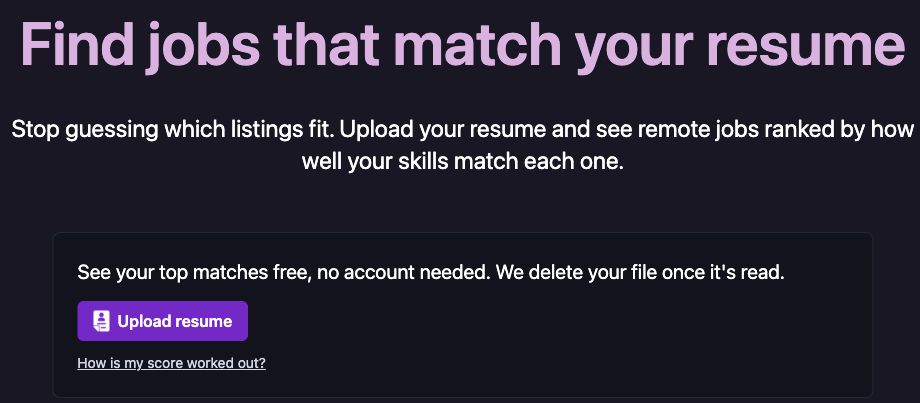
The public resume matcher explains its score as weighted keyword coverage. It says the score does not weigh years of experience or salary. Top matches are available without an account; viewing all matches requires a subscription.
Use matching to ask practical questions: does the resume demonstrate the required responsibility, are essential skills missing and is the experience level appropriate? A keyword overlap can miss a legal location restriction or a requirement for professional certification. Treat such hard conditions separately from a text-based suggestion.
Training and technical access
The paid offering includes the Remote Job Search MasterClass and API, CLI and MCP access. A course may be relevant if you need a more structured search routine; developer access matters only if you have a permitted technical workflow. Neither is a reason to buy a longer plan when you only need occasional browsing.
The terms require API keys to remain private and prohibit using the data to build a competing job board or resell datasets. They also describe rate limits and restrictions on scraping and retention. This independent site does not call that API, publish a jobs feed or reproduce platform listings. Developer access is a constrained capability, not unrestricted ownership of the data.
Choose capabilities by the task you need done
Remote Rocketship features matter only when they address a real search bottleneck. Someone who needs occasional public browsing may not need alerts, while someone with a stable resume may care mostly about eligible employers. A longer feature list does not make an annual commitment necessary.
Read the workflow guide to connect discovery to applications and the pricing breakdown to compare actual charges. If a feature is central to your decision, confirm that its scope and access conditions meet your needs before paying.
Common questions
Do all paid plans include the same tools?
Yes, according to the official pricing page. It lists full results and filters, saved-search alerts, resume tools, the Remote Job Search MasterClass and API, CLI and MCP access across the paid plans.
Can I filter by location and experience?
The public interface shows location and experience controls, and the product describes country and time-zone filtering. The paid offer also lists salary, visa sponsorship and seniority. Confirm the final requirements in the employer’s posting.
How often can saved-search alerts arrive?
The pricing page advertises hourly or daily email alerts. Choose a focused search and a frequency that lets you review the results rather than accumulating unread messages.
What does a resume match score tell me?
The public explanation describes a score based on weighted keyword coverage. It says the score does not weigh years of experience or salary. Use it to inspect skill alignment, while checking eligibility and responsibilities separately.
Can I use developer access to republish the job data?
The terms restrict competing job boards, dataset resale, scraping and retention. API, CLI or MCP access is not unrestricted permission to copy the platform’s listings; read the current conditions for your intended use.